Spawn is your seed. It is not a seed in the ordinary sense — it is living mycelium riding on grain. It is the most important thing you will make, and the easiest to ruin.
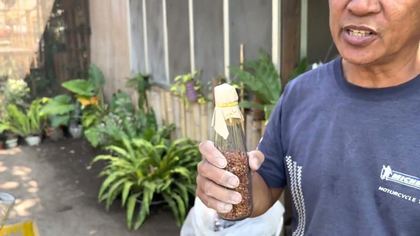
You need a way to carry living mycelium into every bag. Grain is the best vehicle: small, uniform, nutritious, and easy to distribute.
A single sorghum grain full of mycelium is like a small battery. Put it into the substrate and it has enough stored energy to start immediately — it does not have to wait.
More starting points means faster colonisation. That is the whole reason grain is used.
F0 — the original culture, usually on agar or in a small vessel. Everything comes from this.
F1 — the first sorghum bottle inoculated from F0. This is what is called mother spawn.
F2 — bottles inoculated in turn from F1. This is what normally goes straight into the fruiting bag.
At every transfer your spawn multiplies substantially. That is the power of the system.
Do not carry on endlessly — F2 to F3, F3 to F4. With every generation the culture weakens. This is called senescence. Colonisation slows and yield falls.
Go back to fresh culture after a few generations.
And how many bottles per F0, how many bags per bottle, and how long colonised spawn can be stored.
The whole explanation as a PDF you can print and carry out to the farm — and the full course with it, for one payment.
One payment. No subscription.
 Mushy Deli